Gaming Chair vs Office Chair: Which One Should You Actually Buy in 2025?
Gaming Chair vs Office Chair: Which One Should You Actually Buy in 2025?
The question is a gaming chair better than an office chair depends entirely on your primary use case and sitting duration. Gaming chairs evolved from racing seat designs with bucket-style construction, while office chairs draw from decades of workplace ergonomics research. This guide breaks down the real differences in support, comfort, and value to help you choose the right chair for your specific needs.
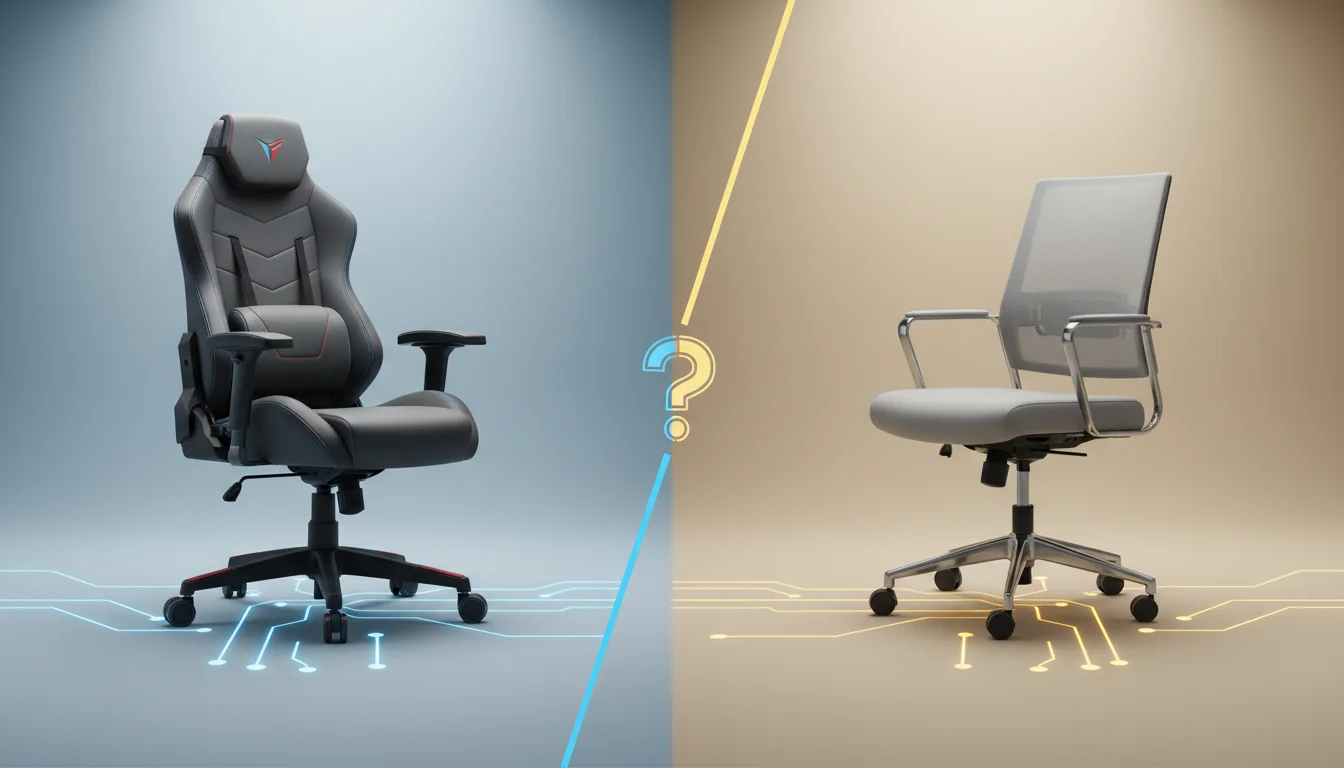
Understanding the Key Differences Between Gaming and Office Chairs
These two chair categories solve different problems with fundamentally different design philosophies.
Gaming chairs borrow their DNA from automotive racing seats. You get high backs, aggressive side bolsters, and bold aesthetics meant to create an immersive experience. Office chairs take the opposite approach with neutral frames, breathable materials, and adjustability refined through decades of ergonomics research.
| Feature | Gaming Chair | Office Chair |
|---|
| Design Origin | Racing/bucket seats | Workplace ergonomics |
|---|---|---|
| Aesthetics | Bold colors, logos, sporty look | Professional, minimalist |
| Headrest | Standard (usually pillow-style) | Often optional or absent |
| Side Bolsters | Yes, prominent | Minimal or none |
| Materials | Synthetic leather, vinyl | Mesh, fabric, leather |
| Price Range | $100 to $800+ | $100 to $2,000+ |
The gaming chair market invests heavily in visual design features that don't enhance ergonomics. A $300 gaming chair and a $300 office chair deliver different value propositions: the gaming chair gives you aesthetics and features like RGB lighting, while the office chair gives you refined adjustability and better materials. Autonomous notes that comparably priced office chairs typically offer superior functionality.
Ergonomics and Lumbar Support: A Side-by-Side Comparison
Quality office chairs integrate lumbar support directly into the backrest structure, while gaming chairs rely on removable pillows that shift during use.
Built-in lumbar mechanisms contour to your spine's natural curve and adjust in height and depth to match your specific body. Gaming chair pillows sit where you place them initially, then migrate as you move throughout the day.
| Lumbar Feature | Gaming Chair | Office Chair |
|---|
| Support Type | Removable pillow | Integrated mechanism |
|---|---|---|
| Adjustability | Position only | Height + depth |
| Consistency | Shifts during use | Stays in place |
| Long-term Support | Pillows flatten over time | Maintains tension |
| Spine Contouring | Generic fit | Customizable curve |
Higher-end gaming chairs from brands like Secretlab now incorporate integrated lumbar systems, closing the gap significantly. But in the $200-400 range where most buyers shop, office chairs deliver more reliable lower back support. BtoD emphasizes that neither category guarantees good ergonomics—quality varies wildly within each.
I spent three months alternating between a $350 gaming chair and a $350 ergonomic office chair. The gaming chair's lumbar pillow needed constant repositioning. The office chair's built-in support stayed exactly where I set it.
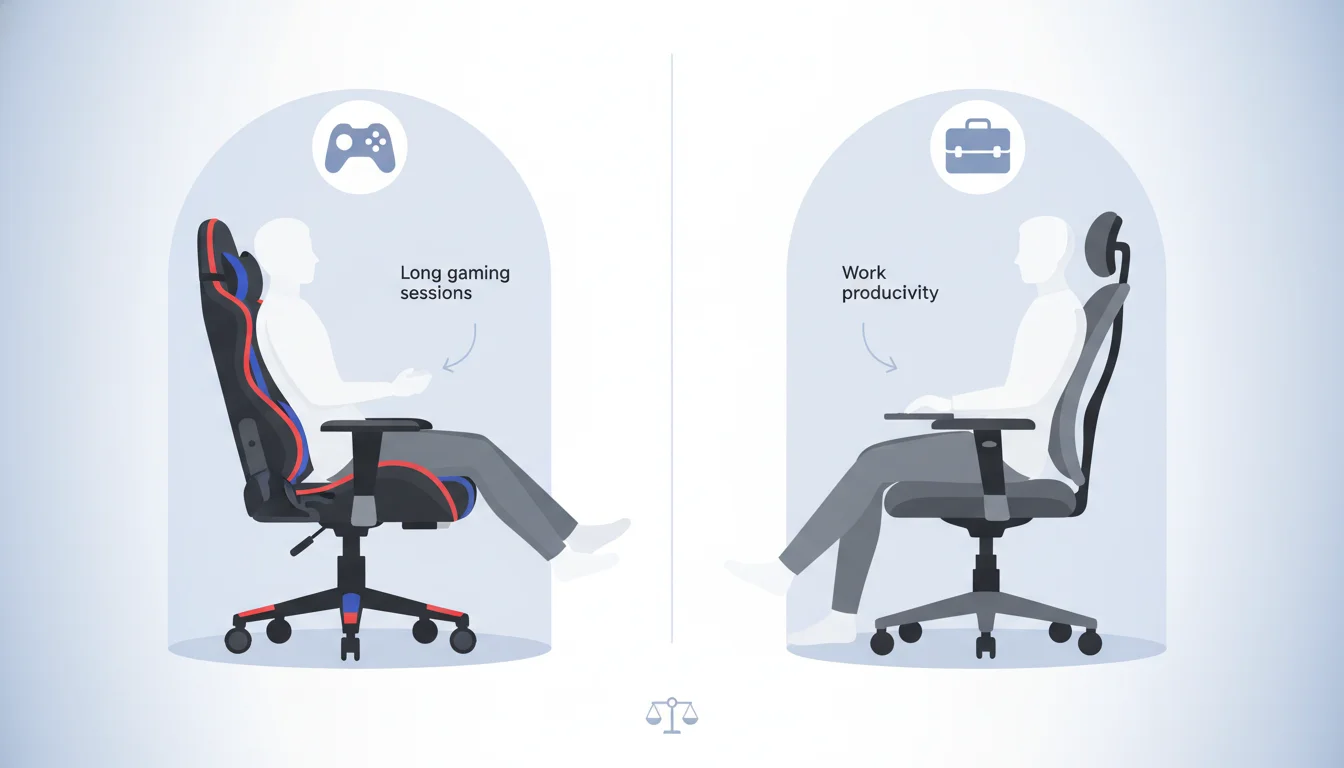
Comfort for Long Hours: Gaming Sessions vs Workdays
Dense foam in gaming chairs feels supportive for the first few hours, then creates pressure points during extended sessions beyond six hours.
Office chairs with mesh backs excel at temperature regulation—your back breathes during an eight-hour workday. Gaming chairs with synthetic leather trap heat, especially in warm environments.
| Comfort Factor | Gaming Chair | Office Chair |
|---|
| Initial Feel | Plush, firm cushioning | Varies by model |
|---|---|---|
| 4-Hour Comfort | Excellent | Excellent |
| 8-Hour Comfort | Pressure points develop | Maintains support |
| Breathability | Poor (synthetic materials) | Good (mesh options) |
| Seat Width | Narrow bucket design | Wider seat pan |
| Movement Freedom | Restricted by bolsters | More position options |
The bucket seat design locks you into one position. Some people find this focusing; others feel trapped after a few hours. Wider office chair seats let you shift between positions throughout the day. [Haworth] points out that high-quality office chairs perform well for gaming when long-term comfort matters most.
Fair warning: if you run hot or live somewhere warm, mesh backs change everything. I switched to mesh during summer, and the difference in comfort was immediate.
Adjustability Features That Actually Matter
Gaming chairs offer flashy 4D armrests and 180-degree recline, while office chairs provide seat depth adjustment and synchro-tilt mechanisms that matter more for daily use.
Essential adjustments include seat height, armrest position, recline angle, and tilt tension. Gaming chairs nail some of these; office chairs handle others better.
| Adjustment | Gaming Chair | Office Chair |
|---|
| Seat Height | Standard | Standard |
|---|---|---|
| Armrests | 4D (height, depth, width, angle) | 2D-4D depending on model |
| Recline | Up to 180 degrees | 110-135 degrees typical |
| Tilt Mechanism | Basic (seat and back move together) | Synchro-tilt (independent movement) |
| Seat Depth | Rarely adjustable | Common on mid-range+ |
| Headrest | Standard (pillow style) | Optional, often adjustable |
| Lumbar Height | Fixed pillow position | Adjustable on quality models |
Synchro-tilt deserves attention. This mechanism reclines your back more than your seat, keeping your feet planted while you lean back. Gaming chairs typically tilt the entire unit together, which lifts your feet off the ground during recline. [Slouch Online] notes that office chairs generally offer more refined adjustment options.
The 180-degree recline sounds impressive. Trust me—you'll use it twice, then forget it exists. Seat depth adjustment that accommodates your leg length? You'll appreciate that every single day.
Price, Value, and What You Actually Get for Your Money
Budget gaming chairs sacrifice ergonomics for aesthetics, while budget office chairs often provide better foundational support at the same price point.
The mid-range sweet spot sits between $300-500. Here, quality gaming chairs and office chairs become genuinely comparable. Below that threshold, office chairs deliver more functional value.
| Price Tier | Gaming Chair Value | Office Chair Value |
|---|
| $100-200 | Aesthetics over function | Better ergonomic basics |
|---|---|---|
| $200-400 | Improved build quality | Strong mid-range options |
| $400-700 | Quality materials, good support | Excellent ergonomics |
| $700+ | Premium features, longevity | Professional-grade support |
Think cost-per-year. A $600 chair lasting 10 years costs $60 annually. A $200 chair replaced every 2 years costs $100 annually. Warranty length signals manufacturer confidence—premium office chairs often carry 10-12 year warranties, while gaming chairs typically offer 2-5 years.
Gaming chair pricing includes a brand tax. You pay for the logo, the streamer endorsements, and the RGB lighting. Office chair pricing reflects materials and engineering. Neither approach is wrong, but know what you're paying for.
Which Chair Type Is Right for Your Specific Needs?
Your primary activity determines which chair delivers the best value for your situation.
Match the chair to how you'll spend most of your sitting hours. Don't buy based on occasional use cases.
Choose a gaming chair if:- Gaming sessions under 4 hours represent your primary use
- You stream or create content and want visual appeal on camera
- Aesthetics matter and you want your setup to look cohesive
- You prefer a locked-in, immersive seating position
- Work-from-home sessions exceed 6 hours daily
- Professional video calls require neutral backgrounds
- You run hot or work in warm environments
- Back pain or posture issues require reliable lumbar support
- Multiple household members with different body types share the chair
Body type matters significantly. Larger individuals often find gaming chair bolsters restrictive because the bucket design assumes a specific frame size. Office chairs with wider seats accommodate more body types comfortably. [Haworth] suggests high-quality ergonomic office chairs as the best all-around option for mixed work and gaming use.
Hybrid options exist. Several manufacturers now build office chairs with gaming aesthetics, giving you the adjustability and ergonomics of a work chair with colors and styling that fit a gaming setup.
FAQ
Do gaming chairs cause back problems?
Poor-quality gaming chairs with inadequate lumbar support contribute to back pain during extended use. The bucket seat design restricts movement, which compounds the issue. Quality gaming chairs with integrated lumbar systems perform comparably to office chairs.
How long do gaming chairs last compared to office chairs?
Gaming chairs typically last 2-5 years with heavy use, while premium office chairs last 10-15 years. Synthetic leather on gaming chairs cracks and peels faster than mesh or fabric upholstery. Warranty length reflects this difference.
Are gaming chairs worth it for office work?
Gaming chairs work adequately for office tasks under 4-6 hours. Longer workdays reveal comfort limitations. The fixed lumbar pillows, restricted movement, and heat retention become noticeable problems during 8-hour sessions.
What's the best chair for both gaming and working from home?
An ergonomic office chair in the $400-600 range delivers the best dual-purpose performance. Look for adjustable lumbar support, seat depth adjustment, and 4D armrests. Several models now offer color options that complement gaming setups.
Should I get a mesh or cushioned chair?
Mesh backs excel in warm environments and long sessions due to breathability. Cushioned chairs feel more luxurious initially but retain heat. Let your climate and typical session length guide this choice.
How much should I spend on a good chair?
The $300-500 range hits the sweet spot for quality and value. Below $200, compromises become significant. Above $700, you encounter diminishing returns unless you have specific ergonomic requirements or want professional-grade durability.
Do expensive gaming chairs have better ergonomics?
Premium gaming chairs from brands like Herman Miller x Logitech and Secretlab offer legitimate ergonomic improvements. Integrated lumbar support, better materials, and refined adjustability close the gap with office chairs. Budget gaming chairs prioritize looks over function.
What chair features matter most for long-term comfort?
Adjustable lumbar support, seat depth adjustment, and breathable materials impact long-term comfort more than recline angle or armrest dimensions. Focus on features that support your spine during typical sitting positions.